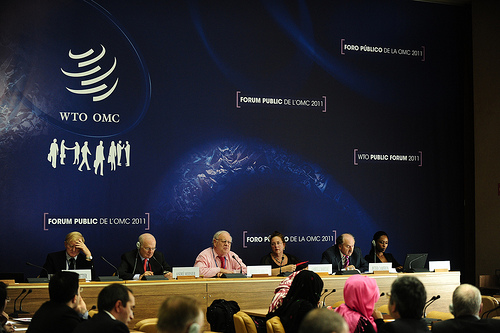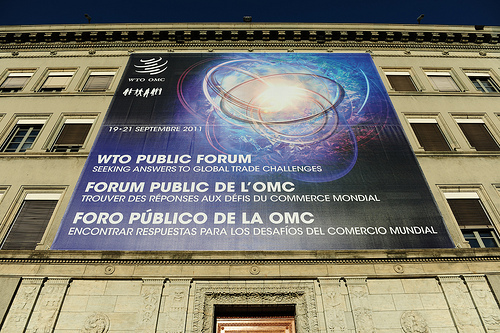
Professor Gabrielle Marceau, Counsellor in the Legal Affairs Division of the WTO, elaborated on the application of the general WTO rules to trade in energy. The main goal of the WTO is to prohibit protectionism. In the energy trade, export restrictions represent a more important concern than import barriers.
The discussion centred on the question of the most effective approach for dealing with energy trade regulation at a multilateral level - through special rules or general rules? Opinions were divided on this issue. Professor Thomas Cottier presented a proposal on creating a framework agreement on energy within the WTO that could refer to pertinent provisions of other agreements outside the scope of the WTO, such as those of the Energy Charter Treaty.
There was a consensus that the principle challenges linked to energy trade are related to different interests between consuming and producing states. Professor Peter Cameron of Dundee University highlighted the importance of the soft non-legal role of international organisations in setting common ground for dialogue. In his view, international organisations should contribute more to the debate on such issues as energy transit. Cooperation between WTO and the ECT is sensible and desirable, in his view, as the ECT provides a noticeable value added to the existing general WTO framework that covers a much larger constituency.
The speakers and members of the audience underlined that the key issue to remember is the need for a balance between the interests of different stakeholders. A necessary condition for reaching such a consensus, and an area where the Charter Process contributes, is the dialogue between different groups of players: consuming, producing and transit countries, at all stages of economic development. From this point of view, noted Amb. Mernier, the ECT has a distinctive role - no other energy-related organisation provides a common platform for the development and implementation of binding disciplines among these different groups of stakeholders.
Background information
Energy resources are exhaustible natural resources that are vital for the development of the modern world. Indeed no sector other than energy has such a tremendous significance for development of other industries, both manufacturing of goods and provision of services. Moreover, the availability of energy and conditions of energy supply have a direct impact on social development and quality of life.
Recent decades have marked unprecedented challenges with respect to energy trade, including the supply crisis of 1970s, increased demand and price fluctuations. Production, distribution and use of conventional energy types such as fossil fuels have created further concerns related to their negative impact on climate change, which necessitates switching to cleaner methods of production and energy efficiency. Considering the increased volumes of energy materials and products traded across the border, the above challenges provide a new incentive to revisit the institutional structure of energy governance. Such governance consists of multilateral, plurilateral, regional, and bilateral treaties covering differing and sometimes overlapping spheres of energy trade and investment. The session provides an opportunity to discuss interaction between existing sets of regulatory frameworks and identify the best ways to address challenges linked to energy trade.
With energy exporting countries having recently joined the World Trade Organization (WTO) or negotiating their accession, the relevance of multilateral trade rules on energy increases. The rules of the multilateral system embodied in WTO have been in the past perceived by some to leave the energy sector outside WTO scope. A possible reason for this belief might have been the fact that discussions on the creation of specific rules for energy in GATT faced difficulties. There is no doubt that these general rules cover trade in energy. Some may argue however that existing WTO agreements are not designed to specifically tackle major issues pertinent to energy trade as they are oriented towards tackling market access issues and thus do not address to the full extent the issues of export restrictions and investment protection, commonly regarded as the most crucial aspects of oil and gas trade.
The distinctive features of energy raises the question of whether energy trade and investment can be effectively regulated by a general international legal framework or whether a more specialised framework is needed. The regulation of the cross-border energy trade has to take into account the difference between energy and other internationally traded commodities. At the same time, it is a real challenge to negotiate multilateral rules for energy trade, as energy markets and trade are constantly evolving. In addition, despite clear interdependence, the interests of consuming and producing countries differ significantly and this makes negotiations of international binding rules covering energy very difficult. There is an irreducible political and strategic component to international energy trade and many countries have been hesitant about creating international legally binding rules on energy. The effectiveness of an energy-specific international agreement would however depend on the extent it could attract different types of stakeholders along the energy supply chain.
To large extent energy relations, including trade and investment in the sector, have been subject to bilateral treaties. However in order to create predictability in the sector, the enforceable multilateral rules are increasingly important. A multilateral legal framework can best ensure predictability and transparency required in conditions of increasing reliance on internationally traded energy and the need for adequate investment.
The aim of the session is to discuss effective ways, from the regulatory perspective, to address challenges related to energy trade - taking into consideration the distinctive features of energy commodities. The session will focus on the international regulation of energy trade by the rules of the WTO Agreements and the Energy Charter Treaty (ECT). The session will provide an opportunity to discuss complementarities that exist between the general WTO framework and the more specialised framework contained in the Energy Charter Treaty, which is based on the WTO framework applicable for energy trade, including among ECT states that are outside the WTO. The Treaty however contains some additional rules relevant for the energy sector, most notably investment rules and more energy-specific transit rules.
Taking into consideration the adverse impact of energy production, consumption and use on environment and climate, sustainability issues will also be examined. In this context the debate would focus on the role multilateral trade rules can play in addressing the above concerns and on how to avoid trade distortions caused by different domestic policies.
Speaker information
Moderator: Roderick Abbott
Roderick Abbott, a member of ECIPE's (European Centre for International Political Economy) Advisory Board, was Deputy Director General of the World Trade Organisation until late 2005. Prior to his position in the WTO, Mr Abbott was the Deputy Director General of DG Trade in the European Commission and Ambassador to Geneva.
Ambassador André Mernier
Ambassador André Mernier is Secretary General of the Energy Charter Secretariat. Before becoming Energy Charter's Secretary General, Amb. Mernier was Head of Energy Services in the Ministry of Foreign Affairs of Belgium and Chairman of the Investment Group of the EU-Russia Dialogue. During his career in the Belgian foreign service André Mernier was appointed as Ambassador of Belgium in Geneva from 1996-1999 and as Ambassador in Moscow from 2000-2004, during which period he was also accredited to Belarus, Moldova, Armenia, Georgia, Uzbekistan, Tajikistan, Kyrgyzstan and Kazakhstan.
Prof. Gabrielle Marceau
Prof. Gabrielle Marceau, Senior Counsellor at the Legal Division of the WTO, served from 2005 to 2010 as Counsellor in the Cabinet of Pascal Lamy, Director-General of the WTO. Gabrielle Marceau is an Associate Professor at Geneva University Law School and an Associate Professor at the Graduate Institute of International and Development Studies in Geneva, and is a prolific scholar, with two books and over 50 articles and essays in the fields of WTO law and international economic law.
Thomas Cottier
Thomas Cottier, Managing Director of the World Trade Institute and the Institute of European and International Economic Law, is Professor of European and International Economic Law at the University of Bern and Director of NCCR Trade Regulation research programme that covers issues of climate change and energy. Thomas Cottier has a long-standing involvement in GATT/WTO. He served on the Swiss negotiating team of the Uruguay Round from 1986 to 1993, first as Chief negotiator on dispute settlement and subsidies for Switzerland and subsequently as Chief negotiator on TRIPs. He held several positions in the Swiss External Economic Affairs Department. He has also served as a member or chair of several GATT and WTO panels. Prof. Cottier has published on a wide range of trade and international law issues.
Peter Cameron
Peter Cameron is Director of the Centre for Energy, Petroleum and Mineral Law and Policy and Professor of International Energy Law at the University of Dundee. Prof. Cameron is a Fellow of the Chartered Institute of Arbitrators and a Special Member of the Association of International Petroleum Negotiators.