
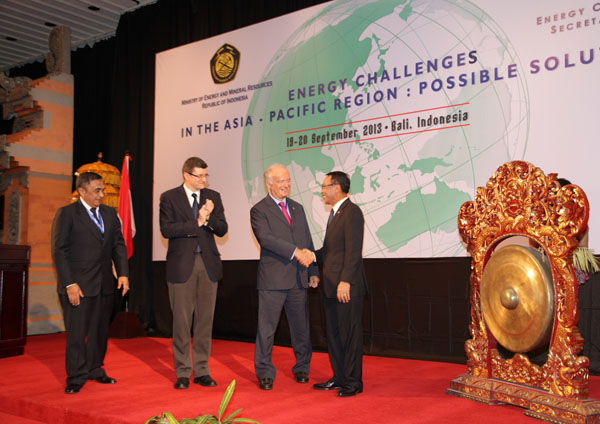
The Energy Charter Secretariat and the Ministry of Energy and Natural Resources of the Republic of Indonesia together with the National Energy Council organised a conference in Bali, Indonesia on 19-20 September 2013 entitled the Bali Energy Forum.
This Forum was themed "Energy Challenges in the Asia-Pacific Region: Possible Solutions". Over the two days many topics of relevance were addressed and the various factors impacting on the energy situation in the Asia-Pacific region were considered.
At the opening of the Forum on 19 September, Mr. Jero Wacik, Minister of Energy and Natural Resources of the Republic of Indonesia, addressed the participants. An observer to the Energy Charter since 2009, Indonesia has already engaged extensively in the Energy Charter Process. The remarks by Minister Wacik were seen to further enhance that engagement. Minister Wacik said that was Indonesia would give careful consideration to the eventual accession to the Energy Charter Treaty.
There were presentations from Indonesian bodies such as the Indonesian Petroleum Association, BPH Migas, BP Indonesia, and the National Energy Council. Participants also heard presentations from the representatives of Energy Charter member countries such as Azerbaijan, Mongolia, Turkey, Finland and Sweden; and from China – an Energy Charter observer country. Participants from India and the Palestinian National Authority also took part in the discussions and expressed great interest in the Energy Charter Process. Mr. Andris Pielbags, the European Union Commissioner for Development addressed the conference via video link and emphasised the potential of the Energy Charter for Asia-Pacific region.
Four panels of distinguished speakers concentrated on the topics of the conference during the second day of the event.
Speaking at the closing session on 20 September, Amb. Selim Kuneralp, the Chairman of the Energy Charter Conference, said that the successful event had been of great value to the Energy Charter Secretariat, and furthermore would be of great value to the Energy Charter constituency. The Energy Charter was undergoing a modernisation process so that the principles of the Charter, which are universal, might reach a wider geographic constituency. The discussions in Bali would be taken into account in the modernisation process to ensure that the Energy Charter remains flexible and ready to respond to the challenges discussed.
Amb. Kuneralp said he had been greatly encouraged by the remarks of Minister Wacik on the possibility of the eventual accession of Indonesia to the Energy Charter Treaty. By doing so Indonesia would give a great lead to its fellow members of the Association of Southeast Asian Nations (ASEAN).
Amb. Kuneralp also remarked on the particular value of the participation and contribution of the business community in the Bali conference and future discussions. The views of the business community brought a practical aspect to the deliberations during the conference.
At the close of the conference, participants agreed on a Concluding Declaration. The Declaration recognises the need for existing international energy organisations like the Energy Charter to modernise their institutional arrangements and objectives in response to the changing global economic and technological realities. ASEAN member states are invited to consider the Energy Charter Process as a useful tool for their domestic energy policy and regional cooperation.