
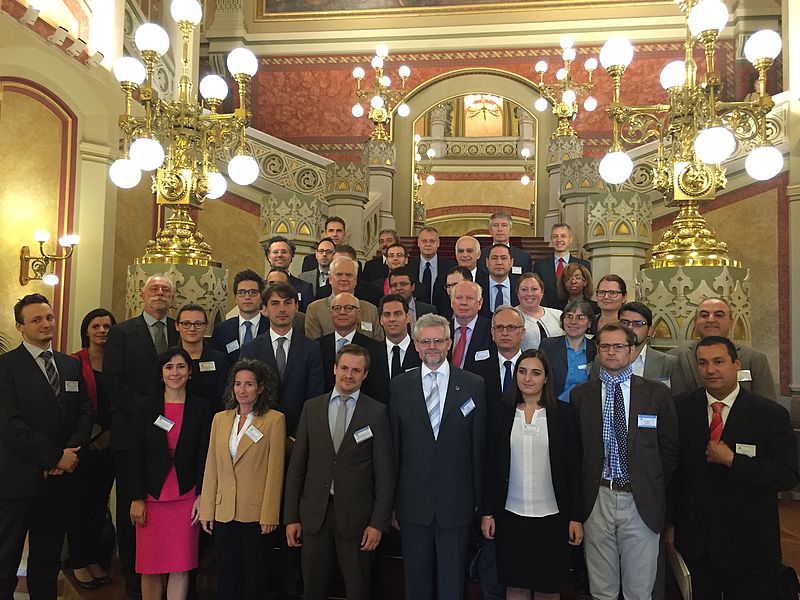
The Energy Charter Secretariat and the Ministry of National Development of Hungary held another successful Forum in its Energy Charter Fora series in Budapest on 7 October 2015 welcoming participants from wide professional and geographical backgrounds, thus having highlighted the wider impact of the Forum well beyond the region of Central and Eastern Europe.
Discussions focused on the topic of "Securing Energy Flows – Energy Union and Beyond" and were organised in three sessions revolving around the issues of:
- the proposed EU's Energy Union and its impact on EU Member States, the EU's external partners as well as the energy industry,
- the natural gas markets and cross-border transport and transit addressing Interconnections and reverse flows as building blocks for energy security, the evolution of natural gas hub trading and future supply options for Europe as well as
- legal frameworks in regional electricity cooperation highlighting the case studies of regional electricity cooperation in Central and Eastern Europe, the development of regional electricity markets in the Energy Charter Treaty area, and prospects for common energy market within the Eurasian Economic Union.
The Forum provided a platform to promote a reliable and secure cross-border transit of energy through various legal frameworks and instruments to address the most salient challenges stemming from cross-border energy flows and welcomed around 80 interested participants from the energy industry, governments, law firms, regulators, consultancies, think tanks, academia and others.
The Forum took place at the heart of Budapest at Pesti Vigadó.
Forum Materials
Session I: Energy Union: What it Means for the EU and External Partners
Dr. András Aradszki
Minister of State for Energy Affairs, Ministry of National Development of Hungary
Dr. Urban Rusnák
Secretary General, Energy Charter Secretariat, Brussels
Christoph Schuh
European Affairs / Head of APG Office, Brussels
Aleksandar Kovacevic
Senior Visiting Research Fellow, The Oxford Institute for Energy Studies
Session II: Natural Gas Markets: Crossborder Transport and Transit
Péter Kaderják
Director, Regional Centre for Energy Policy Research (REKK)
Martin Vladimirov
Economic Programme Analyst, Center for the Study of Democracy
Danila Bochkarev
Senior Fellow, EastWest Institute
Session III: Regional Electricity Cooperation: Legal Framework
Hajnalka Kelemen
Electricity Network Code Project Manager, MAVIR - Hungarian Independent Transmission Operator Company
Kanat Botbaev
Senior Transit Expert, Energy Charter Secretariat, Brussels
Vadim Zakrevsky (in English and Russian)
Deputy Minister of Energy of the Republic of Belarus
Concluding Remarks
Dr. Urban Rusnák
Secretary General, Energy Charter Secretariat, Brussels
Andrea Kádár
Deputy State Secretary for Energy Affairs, Ministry of National Development of Hungary
Background
Energy resources are distributed unequally around the world. This requires transport of resources, both hydrocarbons and electricity, from the producers to consumers located in different territories and across continents. Energy transport and transmission activities are gradually becoming more globalised with improved market access and short-term trading. The growing interdependency and integration of the energy markets raises the importance of ensuring cross-border and transit flows of energy. In this new market environment, the effects of supply disruptions have implications beyond national borders. Therefore, the challenges that lie ahead of energy security (demand, supply and transit security) should be addressed with a view to elaborate common solutions based on mutually agreed principles.
A vision of an integrated continent-wide energy system where energy flows freely across borders was adopted by the European Union (EU) in 2015. This strategy for a European Energy Union focuses on energy security, completing the internal energy market, energy efficiency, decarbonisation, as well as research and innovation. Implementation of Energy Union will require additional legislative procedures and greater political support from 28 EU Member States and also Energy Community contracting parties in order to attain the goal of closer integration of energy markets of the EU and their immediate neighbourhood. Energy Union will use all possible external instruments to achieve these goals. The International Energy Charter broadened the geographic scope of the Energy Charter as more energy producing, consuming and transit countries joined the Charter’s international platform for energy cooperation. Future role of the International Energy Charter in external dimension of Energy Union is hence indispensable.
The necessary transport infrastructure, a common regulatory framework and sufficient interconnection capacity to operate in both directions is critical for more security of supply. There are instruments in the EU to support this and to encourage closer cooperation between the Member States. Gas hub liquidity in the EU has grown over the recent years. There are large liquid natural gas hubs in the North-Western markets and there is a race to establish further physical and virtual hubs in Central and Southern Europe. Furthermore, key infrastructure projects are identified for diversification of sources, suppliers and routes, such as for gas supplies from Central Asia. Turkey is one of the countries the EU wants to intensify relations with under a strategic partnership. All of these ambitions are positive developments but require strengthened dialogue and development of appropriate instruments.
Making energy infrastructure projects feasible is the only way to enhance regional and global integration and to secure cross-border transit flows of energy. There is a risk of financial impediment for investment in energy infrastructure due to the lack of international rules governing their development. The Energy Charter Treaty is the only multilateral treaty that covers four major trading blocs of Eurasia, serves as an umbrella for regional initiatives, particularly in electricity sector. Electricity interconnections and cross-border cooperation allow improved security of supply in terms of diversification of sources, system reliability and economies of scale. A lot remains to be done to achieve electricity integration and liberalisation of trade and investment in the Eurasian electricity market. International cooperation is critical in order to address contemporary challenges to regional and inter-continental interconnectivity and reliable flows of energy.
Objectives of the Forum
Objectives of the proposed forum include:
- Facilitate the dialogue among the stakeholders on reliable and secure cross-border transit of energy.
- Discuss various legal frameworks and instruments to address the most salient challenges stemming from cross-border energy flows.
- Provide platform for cooperation through exchange of information, sharing best practices, technological innovations and lessons learnt.
Target audience
This forum will bring together representatives of governments, energy regulators, industry, academia and international organisations to discuss the concept of a reliable and secure cross-border transit of energy.
- International organisations who might be able to contribute to the topic of discussion;
- Governments – members of the Energy Charter;
- Power sector representatives;
- Insurance companies;
- Academic institutions.