Conferences, Seminars, Workshops and other Events

The Energy Charter member countries should strengthen their capacity to develop and implement energy efficiency policies if the widespread political commitment to improve energy efficiency is to be turned into a reality. This was a main conclusion arising from a Conference on 'Delivering Energy Efficiency', co-organised by the Energy Charter Secretariat and the Ministry of Economy and Finance of Romania, which took place in Bucharest on 23 May 2007.

"The Energy Charter Treaty is a cornerstone of the international legal framework for the energy sector, and I welcome its contribution to achieving key objectives shared by the World Bank - strengthening the rule of law, securing reliable energy supply and encouraging the flows of trade and investment that can promote sustainable economic growth", said Ana Palacio, the Secretary General of the International Centre for Settlement of Investment Disputes (ICSID) and Senior Vice President of the...

There is great potential to increase the share of bioenergy in the overall energy mix in Energy Charter member countries, but this will require significant investments, cooperation in research and development, and improved access to technologies. This was a main conclusion of an international meeting on cooperation in the development of bioenergy technologies, which took place in Chisinau, Moldova, on 10 May 2007, co-organised by the Energy Charter Secretariat with the Ministry of Industry and...

Countries from Central and Southern Asia have agreed to use the Energy Charter framework as a means to intensify and develop cross-border electricity trade.

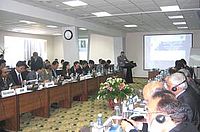
This was the result of a high-level workshop on Electricity Cooperation in Central and Southern Asia, which was organised by the Energy Charter Secretariat together with the Ministry of Energy, Industry and Fuel Resources and the Ministry of Foreign Affairs of Kyrgyzstan, with financial support from the Government of Norway.

At the meeting...

On 20 November 2006, the 17th Meeting of the Energy Charter Conference took place in Brussels, Belgium.

Putting the global energy economy on a secure and sustainable path of development will require renewed efforts from governments and international organisations. This was a key message from a high-level Conference, organised jointly by the Energy Charter Secretariat, the International Energy Agency (IEA) and the Organisation for Security and Cooperation in Europe (OSCE) on 25 October 2006 in Brussels, on the role of governments and international organisations in promoting energy security .

"Oil and gas pipelines are the arteries of the global energy economy. Putting new pipeline infrastructure in place requires extensive cooperation between states and with investors, and the Energy Charter is looking to contribute a transparent, balanced and neutral starting point for negotiations on new projects", said André Mernier, the Secretary General of the Energy Charter Secretariat, at the opening of a two-day expert workshop on 17-18 October 2006 in Brussels.

A follow-up meeting to 'Brussels workshop on providing reliable gas transit' of 19 May 2006 was organised in Bratislava in cooperation with the Ministry of Economy of the Slovak Republic on 27 September 2006, on the eve of the Annual Conference of Gas Infrastructure Europe, the association representing gas transmission companies, storage system operators and LNG terminal operators in Europe. This workshop brought together government and industry experts from across the Energy Charter...

The rapid growth of international trade in natural gas is highlighting the importance of mechanisms that can ensure the reliability of cross-border energy flows. Such mechanisms are particularly important for gas supply to Europe, where existing and planned pipeline routes often cross multiple national borders on their way from producer to consumer.

Removing barriers to trade in electricity has been a feature of the work of the Energy Charter, and the Energy Charter Secretariat organised on 16 May 2006 a roundtable meeting on cooperation, which aimed to analyse the costs and benefits of greater interconnection and discussed the instruments that could be needed to foster increased cross-border trade. The discussion was based on a series of regional examples from Southeast Europe, the Caucasus and from Central Asia, and served as guidance for...