
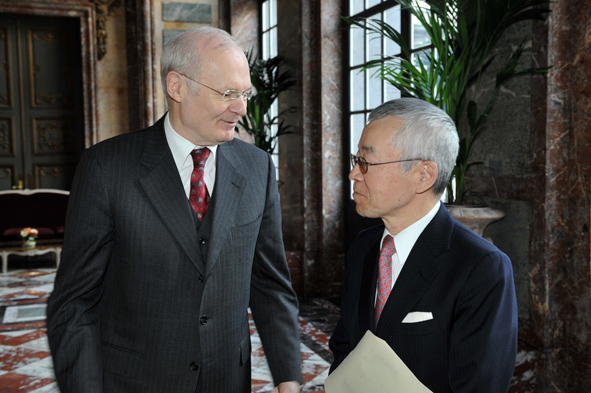
The reception brought together numerous high-level guests: former and current leaders of the Energy Charter Process, ambassadors of Energy Charter Treaty member countries, representatives of international organisations and institutions, former and current members of the Secretariat. Commemorative speeches were delivered by the former Prime-Minister of the Netherlands and founding father of the Energy Charter process Mr. Ruud Lubbers, the former Chairman of the Energy Charter Conference Amb. Charles Rutten, the former Chairman of the Energy Charter Conference Mr. Henning Christophersen, the current Chairman of the Energy Charter Conference Amb. Takekazu Kawamura and the Secretary General of the Energy Charter Secretariat Amb. André Mernier.
"While this ten-year period is not very long for an international treaty, the Energy Charter Treaty has proven to be a successful and well-functioning legal instrument thus far, and it has everything to continue serving the best interests of its members in the years to come,"
stated the Secretary General of the Energy Charter André Mernier at a ceremony held in Brussels to mark this very important milestone. Ambassador Mernier highlighted that while international energy markets are evolving rapidly, the Energy Charter Treaty remains a vital legal instrument within this rapidly changing and challenging global environment.
"Designed not just to resolve a set of issues of the moment at the time of negotiations, but to set up a legal framework for key dimensions of international energy relations - security of investment and security of supply and demand - the Treaty naturally caters for the demands of the changing international energy market,"
said Ambassador Mernier. The Energy Charter's responsiveness to energy markets is underscored by the fact that it is a multilateral instrument designed for the entire energy value chain, coupled with its application to producer, transit and consumer states alike.
The Treaty both acknowledges and embraces the global nature of the present-day interdependencies of international energy markets - reflected by increased cross-border flows of energy investments and trade in energy materials - and during the past decade has consolidated itself as both an adequate and relevant instrument, strengthening the energy security of its 51 member states. While this does not imply that the Treaty has reached its limits in protecting the interests of its members - efforts to successfully finalise the draft Transit Protocol, or to welcome new members such as major consumer markets like China and India still remain - there is every likelihood that there will be an even greater demand for the Energy Charter Treaty in the years to come.