All News

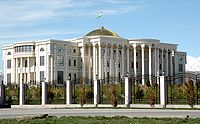
On June 8, 2010, the Energy Charter Deputy Secretary General, Amb. Vladimir Rakhmanin delivered an opening statement at the High-Level International Conference on the mid-term comprehensive review of the implementation of the International Decade for Action "Water for Life 2005-2015", which took place in the capital of Tajikistan, Dushanbe.

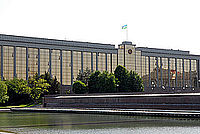
On 18-19 May 2010, the Secretary General André Mernier visited the capital of Uzbekistan to meet with high-level government officials and to discuss the ways for enhanced energy cooperation among the Central Asian republics.

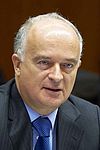
On 7 April 2010, H.E. Ambassador Selim Kuneralp was appointed Chairman of the Energy Charter Conference. The new Chairman is currently Ambassador, Permanent Delegate, of the Turkish Permanent Delegation to the European Union and has enjoyed a distinguished career with the Turkish Foreign Ministry. Previously he worked as an official at the GATT, served as the Turkish ambassador in Sweden and South Korea, as the Director General of the Directorate for Policy Planning of the Turkish MFA and most...

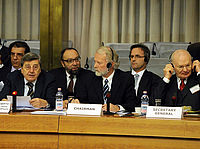
On 22 March 2010, the Energy Charter Conference approved a mandate for the establishment of a Strategy Group. The creation of the Strategy Group follows the adoption of the Rome Statement at the 20th Meeting of the Conference on 9 December 2009.

The Rome Statement provided a political agreement on measures to advance the Energy Charter Process and its modernisation. With the adoption of the Rome Statement, the Charter Conference recognised that the Energy Charter Process must reflect new...

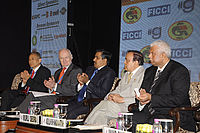
On 22 March 2010, the Energy Charter Secretary General, Ambassador André Mernier, opened the 6th Asian Gas Summit in New Delhi, India. In his keynote presentation the Secretary General highlighted the dynamic character of Asia's energy markets. He noted that the pace of growth in these markets had already exceeded many predictions and looks set to continue in the decade ahead. Indeed, global growth in energy demand is increasingly driven by Asia with the

Organisation for Economic Co-operation...</p>

Following the successful ratification by thirty-five Energy Charter Treaty Signatory states, the Trade Amendment to the Energy Charter Treaty has entered into force on 21 January 2010.* This brings the Treaty's trade provisions, which were initially based on the trading regime of the General Agreement on Tariffs and Trade (GATT), into line with the rules and practices of the World Trade Organisation (WTO).

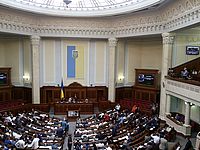
On 9 October 2009, the Energy Charter Secretary General Amb. André Mernier addressed the 55th Atlantic Treaty Association General Assembly meeting in Kiev, Ukraine, on the issue of "Promoting Energy Security in the Black Sea Region: the Role of the Energy Charter Treaty". In his speech the Secretary General highlighted the dual role of the Black Sea as a major energy transit region with global importance and as an emerging energy producer region of considerable potential.

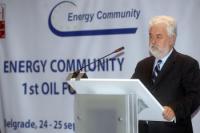
Opening the First Oil Forum in Belgrade on 24 September 2009, the Serbian Prime Minister, Mr. Mirko Cvetković, announced that accession to the Energy Charter Treaty is a matter of exceptional importance in light of the encouragement that the Treaty provides for foreign investment in the country's energy sector.

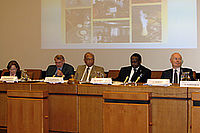
On Wednesday 16 September 2009, Energy Charter Secretary General André Mernier participated in the 12th Scientific Forum of the International Atomic Energy Agency (IAEA) in Vienna, Austria. Addressing the Forum on the subject of ‘The Adequacy of Existing International Energy Institutions in Advancing Energy for Development', the Secretary General highlighted the pressing need for the international community to address global energy poverty.

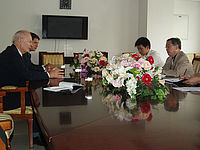
On 1-2 September 2009, the Secretary General André Mernier paid an official visit to Beijing upon the invitation of the Chinese authorities. China became an observer to the Energy Charter Conference in 2001. Meetings held with high ranking officials of the Chinese government provided an opportunity to discuss current challenges in the energy sector, the role of international organisations, such as the Energy Charter, and China's involvement in the Energy Charter Process.

On 6 July 2009, Ukraine submitted to the Energy Charter Treaty Depository the instrument of ratification of the Amendment to the Trade-related Provisions of the Energy Charter Treaty approved by the Verkhovna Rada of Ukraine earlier this year. Ukraine is the thirty-fourth state to ratify the Trade Amendment. The Trade Amendment is set to enter into force upon ratification by at least thirty-five Energy Charter Treaty member states, in accordance with Articles 42 and 44 of the Energy Charter...

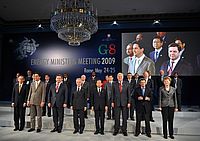
The Energy Charter attended the G8 Ministers of Energy meeting held in Rome on 24-25 May 2009. This was the first occasion that the Energy Charter participated in the work of the G8. The Charter's contribution was focused in Session Three of the meeting which was devoted to the topic of ensuring access to the energy resources necessary to promote development, notably in Africa. Ahead of the meeting, the Energy Charter Secretariat provided a background paper for the consideration of the...

Speaking at the conference "Ensuring Reliable Gas Supplies to Europe and Prospects for Gas Business Development" in Berlin on 19 May 2009, the President of Eurogas, Mr. Domenico Dispenza, underlined the broad support that the Energy Charter Treaty commands internationally. 

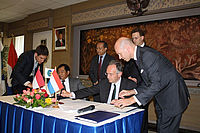
After three years of negotiation between the Government of the Republic of Indonesia and the Energy Charter Secretariat, and following the Energy Charter Treaty member states' unanimous decision on 26 May 2009, Indonesia became the 74th country participating in the Energy Charter Process. Indonesia signed the 1991 Energy Charter in Brussels, at a reception hosted by the Indonesian Ambassador, Nadjib Riphat Kesoema.

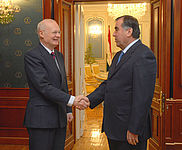
During his visit to Dushanbe on 5-6 May 2009, the Secretary General André Mernier met with the President of Tajikistan Emomali Rahmon. Among the issues discussed at the meeting were the current situation in Tajikistan's energy sector and its potential in developing energy networks in the region through cross-border cooperation.