
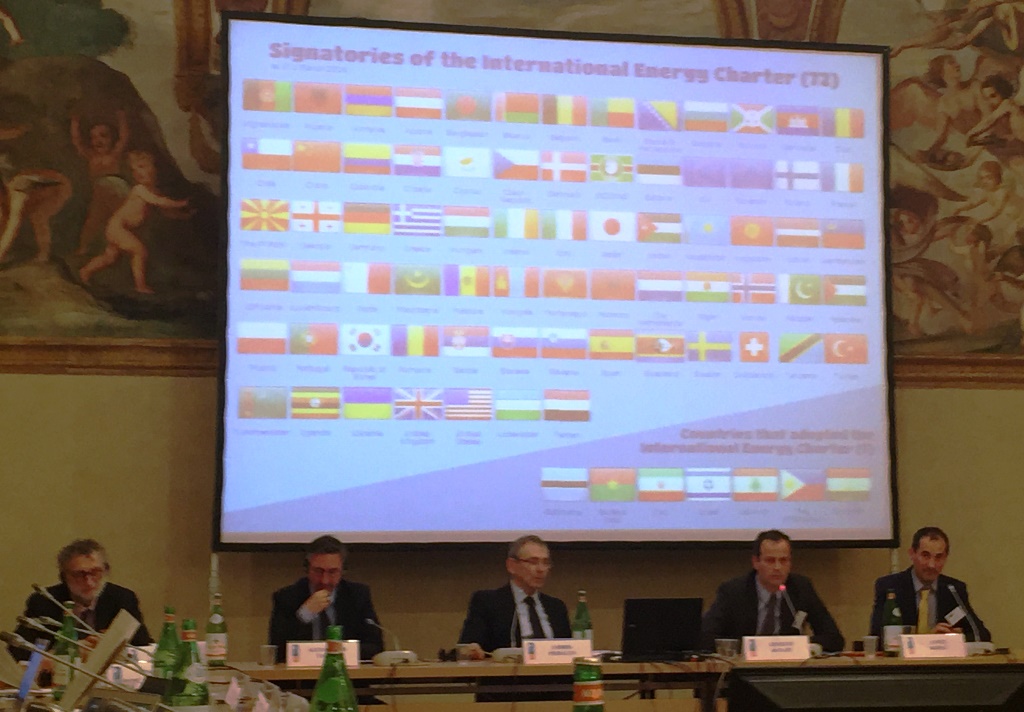
The Vice-President of the European Commission, Mr. Maroš Šefčovič, delivered a keynote address. The conference was divided into three sessions:
- The Global Challenges of the Security of Gas Supply,
- The Internal Market: a Hostage or Saviour of the External Energy Policy? and
- The Impact of the EU’s External Energy Policy on the EU Neighbourhood.
The programme included among the speakers Mr. Dmytro Vovk (Chairman of NERC Ukraine), Mr. Andrei Kortunov (Director General of Russian International Affairs Council), Mr. Hans van Steen (Head of Unit – International Relations and Enlargement, DG Energy, European Commission) and Mr. Janez Kopač (Director of the Energy Community Secretariat) and Mr. Alexandros Yannis (Senior Expert, Energy Diplomacy at the European External Action Service).
The Energy Charter Secretariat was represented by its trade and regulatory expert Mr. Ernesto Bonafé, a former researcher at the European University Institute and at the Florence School of Regulation. Mr Bonafé made a presentation on the role that the International Energy Charter can play in the external dimension of the European Union (EU) energy policy. Particularly he referred to the EU policy in the Eastern and Mediterranean neighborhood, the international initiative to design a multilateral transit regime involving China, Central Asia and applying also to East-East interconnections such as TAPI (Turkmenistan-Afghanistan-Pakistan-India), and new international trends on investment protection.
The Energy Charter shares with regulatory authorities the objective to provide stable and attractive investment environments for energy markets. This is entirely consistent with the academic and training activities of the Florence School of Regulation.