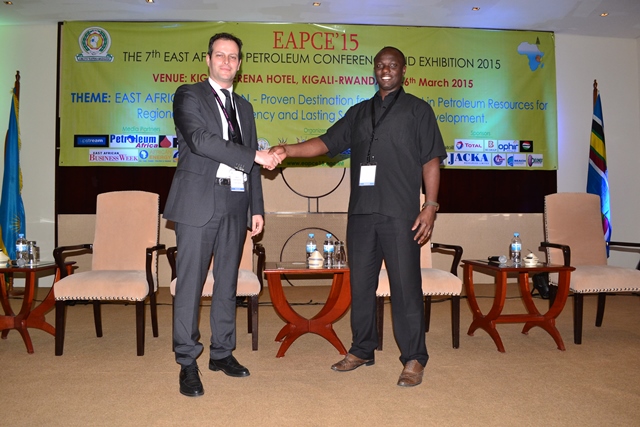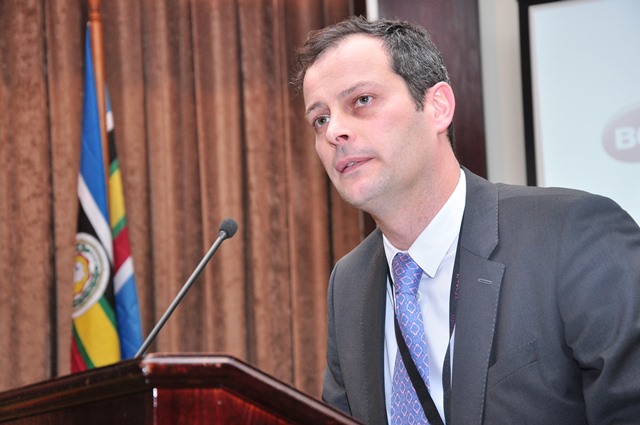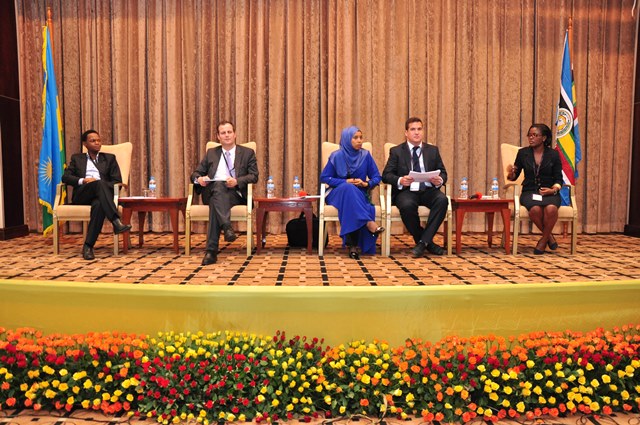
Dr. Ernesto Bonafé, Senior Expert at the Energy Charter Secretariat, delivered a presentation on the International Energy Charter at the 7th East African Petroleum Conference and Exhibition held on 4-6 March 2015 in Kigali, Rwanda. Dr. Bonafé argued that this political declaration, which would be adopted by over eighty governments on 20 May 2015 during a Ministerial Conference in The Hague, The Netherlands, was relevant for countries from all continents. Universal principles, such as national sovereignty over natural resources, unimpeded flow of investments and technology, trade and universal energy access need to go hand in hand with an increasingly global and interdependent energy sector.
Dr. Bonafé highlighted that it was important that East African countries give an international projection to their national and regional concerns, such as consistency of energy policies, economic and social development, environmental protection and access to sustainable and affordable energy for all. The adoption of the International Energy Charter would send a clear message to the international community and stakeholders about the willingness of governments to keep their national policies in line with international standards. It is from that perspective, that the Republics of Tanzania and Uganda had recently expressed their intention to participate in the Ministerial Conference in The Hague for the adoption of the International Energy Charter.
During the concluding session of the conference, Amb. Dr. Richard Sezibera, Secretary General of the East Africa Community, stressed the need to move from the potentiality of natural resources to their commerciality, together with the private sector, to which he referred as a partner. While the technology existed, he noted, what needed to be reinforced was the long-term commitment to a stable regulatory framework. It is up to all countries, from Africa and across the world, to take part in shaping global energy governance.
In the margins of the conference, Dr. Bonafé and Mr. John Kitonga, Senior Engineer at the Ministry of Energy of Tanzania and former secondee to the Energy Charter Secretariat in Brussels, held high-level meetings with the delegations of the five countries of the East Africa Community:
- Uganda, represented by Hon. Eng. Irene Muloni, Minister of Energy and Mineral Development, and Permanent Secretary Mr. Frederick Kabagambe-Kalisa
- Tanzania, represented by Hon. Charles J.P Mwijage, Deputy Minister for Energy and Minerals, and Eng. H.A. Mbise, Commissioner for Energy and Petroleum Affairs
- Kenya, represented by Mr. Martin Mwaisakenyi Heya, Commissioner for Petroleum at the Ministry of Energy and Petroleum
- Burundi, represented by Ing. Jean Berchmans Niragira, Permanent Secretary of the Ministry of Energy and Mines, and Ing. Gratien Ntirandekura, Director of Geology
- Rwanda, represented by Dr. Vicent Biruta, Minister of Natural Resources