
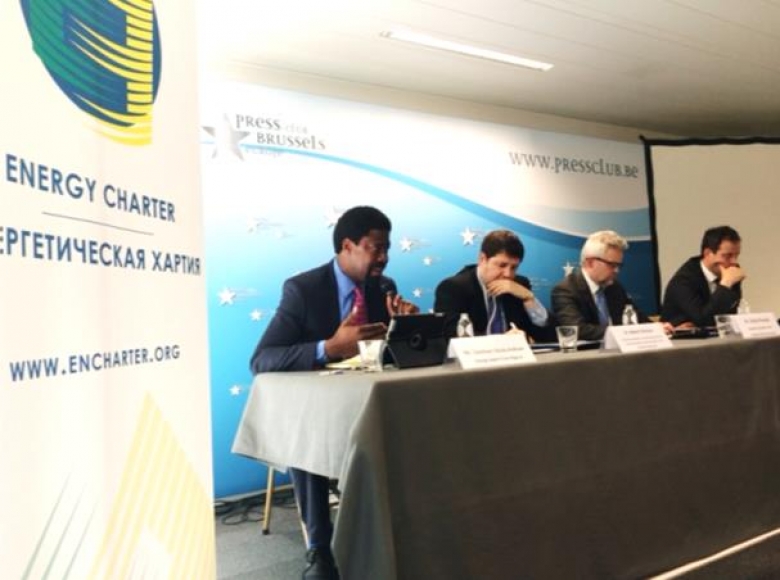
Dr. Urban Rusnák, Secretary General of the Energy Charter Secretariat, stressed the need for investment in energy as a priority in policy makers' agendas and gave some insights on how the International Energy Charter and the Energy Charter Treaty would help alleviate energy poverty in developing nations, how they could promote sustainability and social and economic development. The Secretary General also mentioned how the Energy Charter already provided additional expertise to Sub-Saharan energy officials who were invited to the Energy Charter Secretariat for short-term appointments. The Secretary General informed the press conference attendees that a good number of African countries would sign the International Energy Charter during the Ministerial Conference in The Hague on 20 May 2015, and that these countries were willing to benefit from the advantages stemming from joining the Energy Charter Process. "Our aim in Africa," said Dr. Rusnák, "is empowering countries and the Energy Charter can offer them the tools and expertise to address fundamental issues like sustainability ad access to affordable energy."
Dr. Marat Terterov, Principal Coordinator, gave some insights on the early stages of the Energy Charter and explained the difference between the Energy Charter Treaty and the International Energy Charter. In particular, Dr. Terterov highlighted how the Treaty helped former-Soviet Union countries in their economic transition from planned to market-oriented structures. Since then, however, much had changed and the Energy Charter had begun a process of modernisation that needed to take into account the role of new countries like, for example, China, Angola and Nigeria, whose energy dynamics are of fundamental importance in today's energy markets. The International Energy Charter is the most important result of this process to date, and it represents an opportunity for new countries to engage with the Energy Charter and governance reform.
Mr. Uwakwe Azikiwe is a secondee from Nigeria at the Energy Charter Secretariat, working on the assessment report for his country. He gave press conference attendees a general introduction to the Nigerian energy market challenges and opportunities. While explaining that Nigerians were a very young and vibrant population, he stressed that Nigeria was one of the most natural resource-rich countries of the African continent. However, continued Mr. Azikiwe, access to energy was still too limited, poverty hindered Nigeria's economic and social development. Mr. Azikiwe highlighted the direct correlation between poverty and energy: no country has ever been able to tackle poverty without at the same time addressing the issue of lack of energy access. Energy is key for national development and foreign investment promotion, and this is crucial not only for Nigeria, but for the whole continent. In order to address the issue of energy access and poverty alleviation, Nigeria, and Africa in general, need the Energy Charter and the legal framework its Treaty offers. The latter, claims Mr. Azikiwe, will help promote and attract the investment needed for energy infrastructure development and the electrification of Nigeria. The principles of the Energy Charter, including the rule of law, are what the country and the continent need.
Dr. Ernesto Bonafé, Trade and Regulatory Expert at the Energy Charter, told the press conference participants that the Energy Charter was coordinating its activities within the framework of the "Technical Assistance Facility for Sustainable Energy for All" led by the European Commission. The Energy Charter is a valuable international benchmark, as such it has been invited to participate in this framework as a reference for developing countries. Dr. Bonafé informed participants that the project included Nigeria, Mauritania, Mozambique and Tanzania, and many other African countries expressed their interest in becoming involved in the Energy Charter Process.
The press conference was followed by a small reception where speakers had the chance to answer more specific questions on the topic of discussion.