
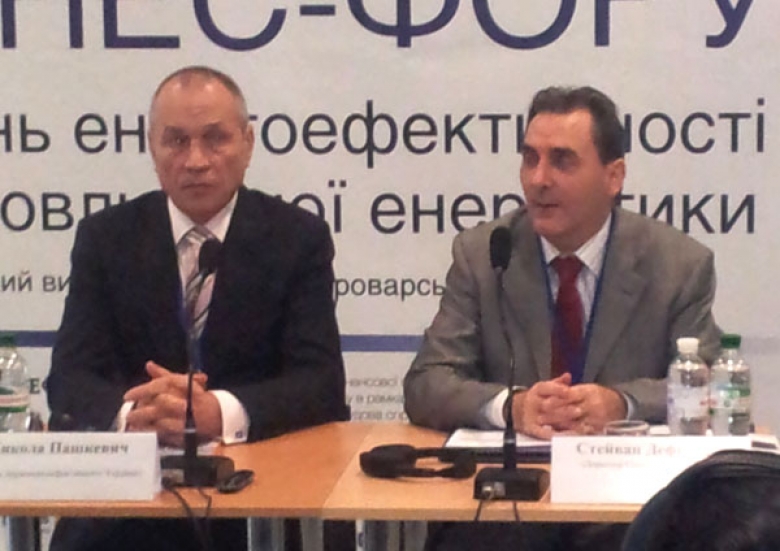
Mr. Steivan Defilla, Director at the Energy Charter Secretariat, reported on the main conclusions and recommendations stated in the In-depth Energy Efficiency Review of Ukraine. The event was attended by high-level representatives of the Ukrainian authorities, international organisations, donors and International Financial Institutions (IFIs), including the European Union Delegation to Ukraine, the World Bank, the European Bank for Reconstruction and Development (EBRD), the United Nations Development Programme (UNDP) and others. In the course of the presentation all the participants could express their views on the work done by the expert group, recommendations set out in the Review and the future development of energy efficiency in Ukraine.
Ukraine ratified the Energy Charter Treaty and the Protocol on Energy Efficiency and Related Environmental Aspects in 1998. By ratifying the Protocol, countries commit themselves to formulating and implementing policies for improving energy efficiency and reducing the negative environmental impacts of the energy cycle.
The in-depth review of energy efficiency policies of Ukraine was carried out in 2013, following an invitation from the State Agency on Energy Efficiency and Energy Savings of Ukraine. The resulting report was discussed by the Energy Charter’s Working Group on Energy Efficiency in October 2013 and the recommendations were endorsed by the organisation's top governing body the Energy Charter Conference.
The document represents a detailed overview and analysis of the current and planned policies to improve energy efficiency in Ukraine. It also provides a number of recommendations for the Ukrainian authorities. In particular, the review includes an assessment of Ukraine's energy policy, energy efficiency policy and its funding and highlights the issue of renewable energy and the environment.
The report concludes that the government of Ukraine should recast and adopt as soon as possible a national energy strategy. Such a recast needs to be based on well-founded assumptions, realistic projections and the acknowledged potential energy efficiency gains. At the same time all necessary and desirable reforms should be accelerated so as to radically improve i) the prospects for investment and ii) perceptions of Ukraine as measured by the metrics of reputable international bodies.
Furthermore, the review team recommends that in order to improve the institutional framework on energy efficiency, high standards of governance are to be obtained in the formulation of the energy and energy efficiency policy and in its implementation through energy market liberalisation, utility privatisation and the regulation of competition.
Regarding the institutional framework, in the opinion of the expert group, the status of the State Agency on Energy Efficiency and Energy Savings of Ukraine needs to improve. Apart from this, sufficient human and financial resources are to be allocated to the Agency as the leading body, responsible for the development and implementation of energy efficiency programmes.
Regarding energy markets and pricing, the report recommends that an integrated approach be taken by the authorities to individual metering, end-use efficiency, comfort and other benefits in tandem with price rises, at the same time ensuring that energy affordability is closely monitored and that remedial actions to alleviate hardship are taken whenever necessary.
Multi-annual state funding needs to be allocated to leverage the huge energy efficiency potential of the economy to improve welfare, competitiveness and the environmental impact. Necessary reforms have to take place to allow for multi-annual municipal budgeting and for the retention of savings resulting from investment in energy efficiency, so as to provide appropriate incentives for municipal actions.
It is important to note that this was the first public presentation of an in-depth review of energy efficiency policies in the Energy Charter Secretariat's practice.