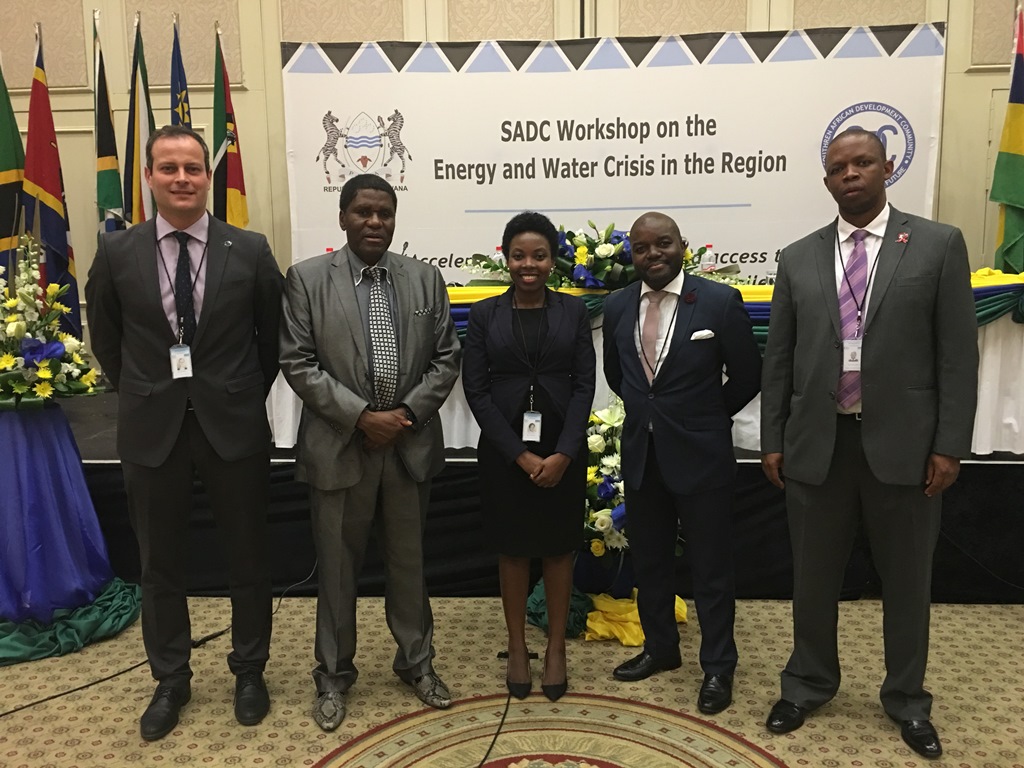
The Energy Charter Secretariat was invited by the Secretariat of the Southern African Development Community (SADC), an organisation gathering 15 countries, to participate in the meeting of SADC Senior Officials responsible for energy on 17 June 2016 in Gaborone, Botswana. This was an important opportunity to present the International Energy Charter and its relevance to SADC Member States and to SADC as a whole. Tanzania and Swaziland who are already observer countries to the Energy Charter Conference, were invited to share their experiences with other Member States on the benefits and challenges associated with the Energy Charter. The SADC Ministers responsible for energy will be asked to take note of those developments at their 35th Meeting on 21 June 2016, one day after their participation in the SADC Joint Energy and Water Ministerial Workshop under the auspices of the President of the Republic of Botswana and Chairperson of SADC, His Excellency Lt. Gen. Dr. Seretse Khama Ian Khama. Moreover, it is important that economic regional organisations should be actively involved in setting market standards for investment, trade, transit and energy efficiency. That is why SADC will consider the example of the Economic Community of West African States (ECOWAS) and the European Union (EU) who have both already signed the International Energy Charter.
During the meetings in Gaborone, the Energy Charter delegates, Ernesto Bonafé and Victoria Nalule also expressed appreciation of the work regarding the Regional Electricity Regulators Association (RERA), the Southern African Power Pool (SAPP) and the Southern Africa Centre for Renewable and Energy and Energy Efficiency (SACREEE). While these technical bodies are responsible to implement regional arrangements, they can benefit from international recognition and endorsement as well as from a platform that connects them to organisations involved in the same endeavors in the African continent and across the world. Their activity will enjoy greater visibility and long-term projection.
Under the Energy Charter Process, countries are assured of sovereignty over their natural resources and their energy priorities and objectives. At the same time, the more countries and organisations who subscribe to the principles of the International Energy Charter, the more stable, transparent, predictable and attractive energy market frameworks will become.