
Chad and Niger became Charter observers on 22 April; an increasing number of Sub-Saharan African countries are confirming their interest in adopting the IEC.
Not yet an observer, Mozambique is already getting involved in the Energy Charter Process. Mr. Anucêncio Bouene, Senior Economist at Mozambique's Ministry of Mineral Resources and Energy, was seconded recently to the Energy Charter Secretariat. He prepared a pre-assessment report on the application of Energy Charter Treaty principles to his country's energy sector. This report will be published shortly on the Energy Charter website and will serve as the basis for further dialogue and engagement with Mozambique.
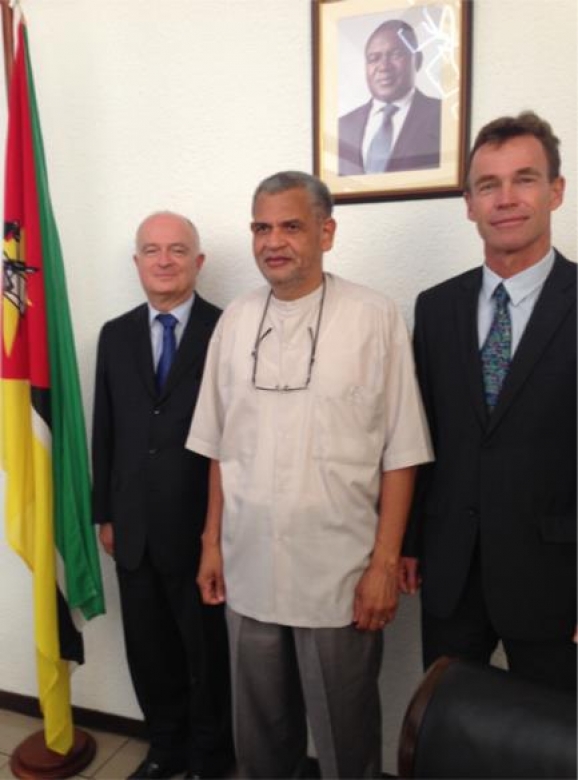
The Deputy Secretary General's meeting with Minister Couto took place as part of a project supported by the European Commission (DG DEVCO) through the Technical Assistance Facility for the Sustainable Energy for All (SE4All) initiative, aiming at promoting an investment-friendly regulatory environment in African countries on the basis of the Energy Charter Treaty. The Head of the EU Delegation in Maputo Mr. Sven Kühn von Burgsdorff participated in the meeting as well.
While in Maputo, Deputy Secretary General Küneralp met with the Ambassador of Turkey Ms. Aylin Tashan and the Ambassador of The Netherlands Ms. Frédérique de Man.
Mozambique has been making progress in providing access to energy for its population over the past decade but much more remains to be done: currently only 40% of the population have access to energy. The development of a diversified range of energy sources is seen as critical for achieving the objectives of energy security, environmental protection and market efficiency. The bulk of the electricity generated at the hydropower plant of Cahora Bassa (2075 MW) is exported to South Africa, and a small amount to Zimbabwe. Hydropower projects are being developed in the Zambezi Valley, totalling at USD 15 bln. There is also a plan to reinforce a backbone transmission line to the south. Mozambique is in a position to accommodate the transit of electricity within the Southern Africa Development Countries.
Mozambique is set to become one of the main gas suppliers of Sub-Saharan Africa, together with Tanzania and Nigeria, as the new natural gas discoveries are expected to increase production to 230 bcm/a in 2040. A natural gas liquefaction facility in northern Mozambique is planned to start operation in 2018; this will allow the country to export gas to international energy markets.